How many times were you stuck on the ground frequency because a student or transient instrument pilot needed multiple corrections to the San Carlos instrument departure procedure? Arguably, the most complicated in the whole country.
“Cessna 123AB is cleared to Stockton Airport via fly runway heading until passing the diamond-shaped waterway, then turn right heading 120° vector to San Jose, V334, Sunol, Modesto, direct. Keep your downwind (120 heading) within 2 miles of KSQL. Maintain VFR at or below 1,100 until passing the OAK 165° radial, then climb and maintain 2,100 feet. Expect 5000 5 minutes after departure. Norcal frequency is 135.65, squawk 1234”.
This is made more difficult by the fact that San Carlos has only one controller operating ground and tower most of the time. By now, I can recite that clearance without hesitation when woken up at 2 am, but let’s be realistic: unless you are aware of that monstrosity, there is no way to get it right the first time.
Many pilots complain about the procedure without realizing that it is there to their benefit. Keeping the departing traffic VFR until passing abeam the 30 numbers, where the OAK R-165 arrives, ensures adequate separation from the San Francisco arrivals. Absent that, Norcal must open a hole in the SFO conga line. Ask yourself, how likely is that to happen?
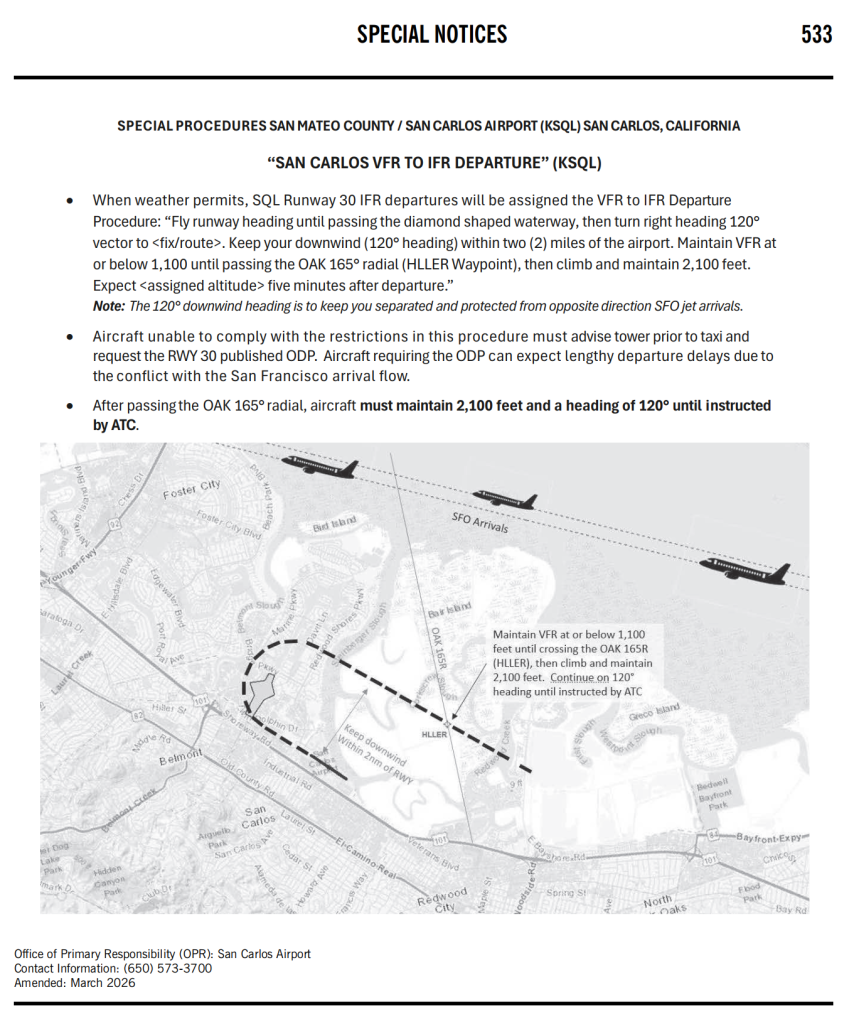
Help has come. In February 2026, Northern California TRACON, aka Norcal, published a Letter to Airmen LTA-NCT-94. You can find it in both ForeFlight and Garmin Pilot, under Procedures, Airport. In addition to the letter, “VFR to IFR Departure” is in the Departure tab in both Jeppesen and FAA Aeronav versions. The procedure is actually located in the Southwest Chart Supplement under Special Notices, on page 533. Foreflight pulls it from there.
It carves out the never-changing part and gives it a name: “VFR to IFR Departure ”. When weather permits, SQL Runway 30 IFR departures will be assigned that procedure. Procedure description says:
“Fly runway heading until passing the diamond-shaped waterway, then turn right heading 120° vector to <fix/route>. Keep your downwind (120 heading) within 2 miles of KSQL. Maintain VFR at or below 1,100 until passing the OAK 165° radial (HLLER Waypoint), then climb and maintain 2,100 feet. Expect <assigned altitude> 5 minutes after departure.”
San Carlos Tower may ask the pilot if he is familiar with the procedure and, if yes, issue a clearance as follows:
“Cessna 123AB is cleared to Stockton Airport, via San Carlos VFR to IFR Departure Procedure, radar vectors San Jose, V334, Modesto, direct. Maintain 2100, expect 5000 5 minutes after departure. Norcal frequency is 135.65, squawk 1234”.
Keep in mind that this procedure can only be used if SQL is VFR with adequate ceiling. You are supposed to maintain VFR on downwind at or below 1100. What happens if the field is IFR with lower ceilings?
You have two options. The only real option is to depart from runway 12, wind permitting. You are IFR from ground up, so the ceiling depends only on your personal minimums. Runway 12 ODP is very simple: climb on heading 123° to 500, then climbing left turn direct SJC VOR.
The second option, runway 30 ODP, says: climb on heading 303° to 600’, then climbing right turn to SJC VOR. This option is impractical because it does require opening the aforementioned hole in San Francisco arrivals. Even the Chart Supplement says so:
Aircraft unable to comply with the restrictions in this procedure (VFR to IFR procedure) must advise the tower prior to taxi and request the RWY 30 ODP. Aircraft requiring the ODP can expect lengthy departure delays.
I did fly the RWY 30 ODP once; the tower assigned it to me. I started to protest, and they assured me there would be no delay, and indeed, there wasn’t. It was April 2020, in the middle of COVID. You may have less luck these days.